


NAPLAN results can be super confusing!
Your child’s report may contain proficiency levels, national averages, comparison ranges and descriptions of the skills students are expected to demonstrate. As a parent, it is not always obvious which part of the report matters most, or if a particular result should be a cause for concern.
The most important thing to understand is that NAPLAN is not a pass-or-fail test. It provides one snapshot of your child’s literacy and numeracy performance at a particular point in time.
A NAPLAN result can help you identify your child’s strengths, notice areas where they may require additional support and begin a more informed conversation with their teacher. However, it should always be considered alongside classroom assessments, school reports, teacher observations and your child’s performance throughout the year.
This guide explains how to read your child’s 2026 NAPLAN results, what the four NAPLAN proficiency levels mean and what you can do if your child receives a lower result than expected.
Table of Contents
- When are the 2026 NAPLAN results released?
- What does NAPLAN assess?
- How to read a NAPLAN student report
- The four NAPLAN proficiency levels explained
- How to interpret each part of the report
- What to do if your child receives a low result
- How to support your child after NAPLAN
- Frequently asked questions
When Are the 2026 NAPLAN Results Released?
Individual NAPLAN student reports are being provided to schools from the beginning of Term 3 in 2026. Schools distribute these reports to parents and carers, with the exact timing varying between states, territories and individual schools. The national NAPLAN results for 2026 are expected to be released separately in August 2026.
This means there are two different types of “NAPLAN results” that parents may see discussed online:
Individual student results
This is your child’s confidential NAPLAN report. It shows how your child performed in each assessment area and how their performance compares with national expectations.
National NAPLAN results
These are broader statistics published by ACARA. They show patterns across Australia, states and territories, year levels and demographic groups.
The national results do not contain your child’s personal result. They also do not provide individual student details.
If your child completed NAPLAN in March 2026 but you have not received an individual student report, contact their school. ACARA does not hold or distribute individual reports directly to parents.
What Does NAPLAN Assess?
NAPLAN is completed annually by Australian students in:
- Year 3
- Year 5
- Year 7
- Year 9.
It assesses four main areas of literacy and numeracy:
- Reading
- Writing
- Conventions of language
- Numeracy.
Conventions of language is divided into:
- spelling
- grammar and punctuation.
This means your child’s report will normally contain separate results for reading, writing, spelling, grammar and punctuation, and numeracy.
 Manoj Arachige
NAPLAN assesses skills students learn through the regular Australian Curriculum. It is not designed to test every subject, every classroom skill or your child’s overall academic ability.
For example, NAPLAN does not directly assess:
- science knowledge
- creativity across all subjects
- oral communication
- practical abilities
- teamwork
- effort
- motivation
- artistic or sporting ability.
It should therefore be viewed as one source of information about your child’s literacy and numeracy development, rather than a complete measure of their potential.
How to Read a NAPLAN Student Report
Your child’s NAPLAN Individual Student Report may initially look complicated, but it can be broken into several key pieces of information.
For each assessment area, the report shows:
- your child’s result
- their proficiency level
- the national average for students in the same year level
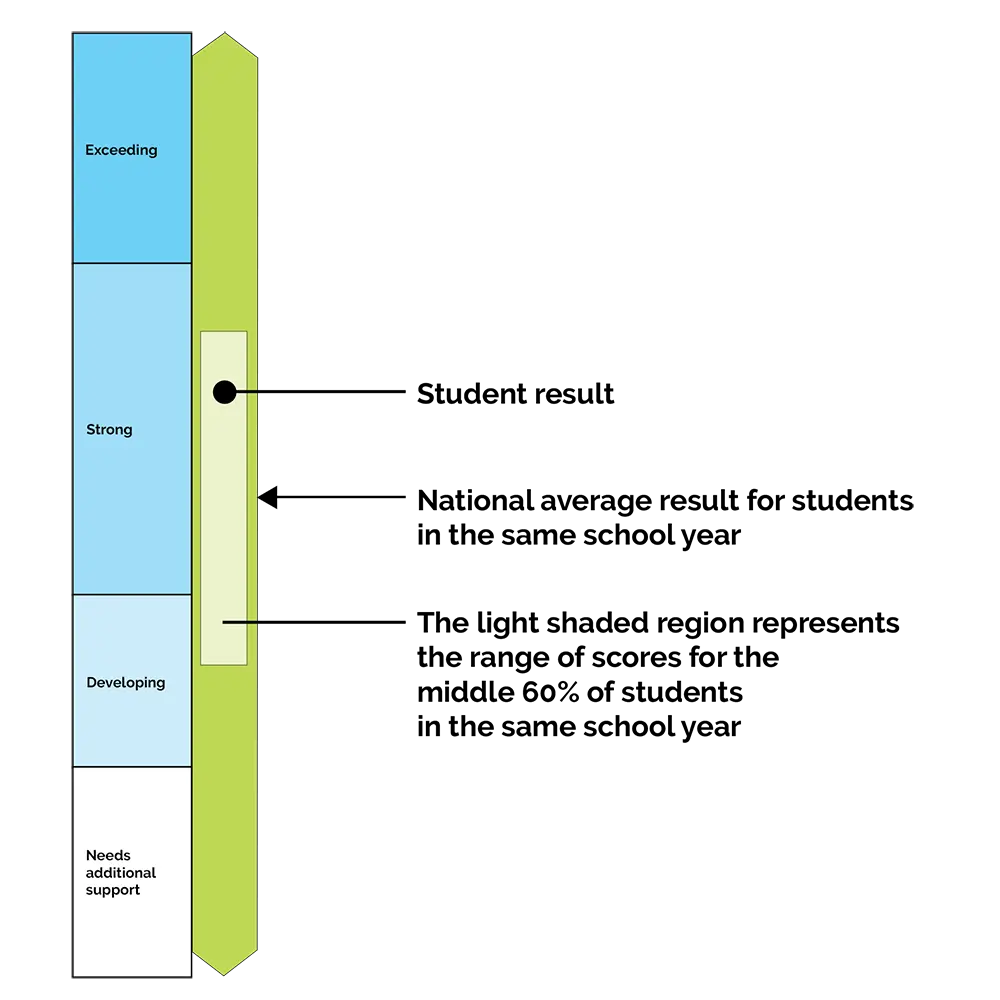
- the range containing the middle 60% of students nationally
- a description of the skills students at different proficiency levels typically demonstrate.
The front of the report contains general information and instructions for reading it. The middle pages show your child’s results, while the final section provides descriptions of the skills generally associated with each proficiency level.
When reading the report, avoid focusing only on whether your child is above or below the national average.
Instead, ask:
- Which areas are their strongest?
- Are the results consistent with their classroom performance?
- Is one area noticeably lower than the others?
- What does the proficiency description say they can generally do?
- Which specific skills should they work on next?
- Has their performance changed since their previous NAPLAN assessment?
The most useful interpretation usually comes from combining the report with information from your child’s teacher.
Manoj Arachige
NAPLAN Proficiency Levels Explained
Since 2023, NAPLAN results have been reported using four proficiency levels:
- Exceeding
- Strong
- Developing
- Needs additional support.
The proficiency expectations are different for each assessment area and year level. A Year 3 student and a Year 9 student may both receive a Strong result, but they are being assessed against different age-appropriate expectations.
What Does Exceeding Mean in NAPLAN?
An Exceeding result means your child’s performance exceeded the challenging but reasonable expectations set for students at their year level at the time of testing.
This indicates that your child demonstrated a sophisticated or advanced understanding of many of the skills assessed in that domain.
For example, depending on the year level and assessment area, an Exceeding result may suggest that a student can:
- interpret complex information
- make detailed inferences when reading
- control more sophisticated writing structures
- use challenging vocabulary effectively
- apply mathematical reasoning to unfamiliar problems
- accurately use complex spelling or grammatical patterns.
An Exceeding result is a strong achievement. However, it does not necessarily mean your child will find every classroom task easy or that they no longer require feedback and challenge.
Parents of students who receive Exceeding results can speak to the teacher about opportunities for extension, advanced problem-solving or more challenging reading and writing tasks.
What Does Strong Mean in NAPLAN?
A Strong result means your child met the challenging but reasonable expectations for their year level at the time of testing.
This is a positive NAPLAN result.
The word “Strong” is not a middle or mediocre category. It means the student is demonstrating the literacy or numeracy skills expected at that stage of schooling.
A student with a Strong result may still have individual skills they need to improve. For example, they may perform strongly overall in writing but require more support with punctuation or paragraph development.
The proficiency level summarises performance across an entire assessment area. It does not mean that every skill within that area is equally strong.
What Does Developing Mean in NAPLAN?
A Developing result means your child is working towards the expectations set for their year level.
This does not mean your child has failed NAPLAN.
It means they demonstrated some of the required knowledge and skills but may require further teaching, practice or support to consistently meet year-level expectations.
If your child receives a Developing result, begin by identifying the specific skills behind it.
For example, a Developing result in numeracy could relate to difficulty with:
- fractions
- place value
- measurement
- interpreting graphs
- mathematical reasoning
- multi-step problems.
A Developing result in reading could relate to:
- identifying implied meaning
- interpreting unfamiliar vocabulary
- connecting information across a text
- distinguishing between main ideas and supporting details
- analysing the author’s purpose.
The result is most useful when it leads to a specific learning plan. “Improve reading” is too broad. “Practise making inferences using evidence from a text” is much more actionable.
Students in the Developing category may require additional assistance, although the type and intensity of support will vary between children. Teachers should interpret the result alongside their knowledge of the student’s ongoing classroom performance.
What Does Needs Additional Support Mean in NAPLAN?
A Needs additional support result means the student did not demonstrate the expected learning outcomes at the time of testing and is likely to require additional support to progress satisfactorily.
Parents should take this result seriously, but it is not a reason to panic or label a child as incapable.
There are many reasons a student may receive this result. These can include:
- gaps in foundational knowledge
- difficulty understanding the test questions
- learning difficulties
- disrupted schooling
- English language development
- test anxiety
- illness, fatigue or distraction on the day
- difficulty using the online test format.
The next step should be a conversation with your child’s teacher.
Ask:
- Does this result match what you see in the classroom?
- Which specific skills does my child find difficult?
- Is further assessment recommended?
- What support will the school provide?
- What can we practise at home?
- How will progress be measured?
- When should we review whether the support is working?
The proficiency result identifies an area that needs attention. It does not, by itself, diagnose a learning disorder or explain why the student is struggling.
NAPLAN Proficiency Levels at a Glance
| Proficiency level | What it means | Suggested parent response |
|---|---|---|
| Exceeding | The student exceeded expectations at the time of testing | Discuss extension and continued challenge |
| Strong | The student met challenging year-level expectations | Continue building skills and address any specific gaps |
| Developing | The student is working towards year-level expectations | Identify weaker skills and discuss targeted support |
| Needs additional support | The student is not yet meeting expected outcomes and is likely to need support | Meet with the teacher and establish a clear support plan |
What Is a Good NAPLAN Result in 2026?
Many parents search for a “good NAPLAN score”, but there is no single score that applies to every student.
The clearest general answer is:
- Exceeding indicates performance above expectations.
- Strong indicates that the student is meeting the challenging expectations for their year level.
- Developing indicates that the student is still working towards those expectations.
- Needs additional support indicates that targeted assistance is likely to be required.
Therefore, both Strong and Exceeding can be considered positive NAPLAN results.
However, the most useful result is not always the highest one. A report that accurately identifies a learning gap can help parents and teachers provide support before the problem becomes more significant.
A child’s result should also be interpreted in context.
For example:
- A Developing result may represent significant improvement for a child who previously required substantial support.
- A Strong result may still reveal a specific weakness requiring attention.
- An Exceeding result may indicate that a child needs greater academic challenge.
- An unexpectedly low result may not reflect the student’s usual classroom performance.
Understanding the National Average and Middle 60%
Your child’s NAPLAN report allows you to compare their performance with students in the same year level across Australia.
It may show:
- the national average
- the range containing the middle 60% of students.
The national average provides a broad reference point. It does not represent a pass mark, nor does every child need to score above it.
The middle 60% shows the range in which the majority of Australian students performed. Your child may appear:
- above this range
- within this range
- below this range.
These comparisons can be informative, but they should not overshadow the proficiency description.
A result slightly below the national average is not automatically a poor result. Similarly, a result above the national average does not mean there are no skills left to improve.
Focus on what your child can currently do and what they need to learn next.
Can You Compare NAPLAN Results Between Years?
NAPLAN results from 2023 onwards can be compared with one another. However, results from 2023 onwards should not be directly compared with results from 2008 to 2022 because the reporting scales and proficiency standards changed.
This means that a student’s 2026 result can be compared more meaningfully with a result from 2023, 2024 and 2025.
However, you should be cautious when comparing a current result with a pre-2023 NAPLAN report that used the former achievement bands and national minimum standards.
Does Staying in the Same Proficiency Level Mean No Progress?
No. A student who receives Developing in Year 3 and Developing again in Year 5 may still have made substantial progress.
The skills required to achieve each proficiency level become more difficult as students move through school. A Year 5 Developing result reflects more advanced expectations than a Year 3 Developing result. ACARA specifically notes that receiving the same proficiency level in successive NAPLAN years does not necessarily mean that a student has made no progress.
Look at:
- the position of the result within the proficiency range
- the skills described on each report
- classroom assessments
- teacher feedback
- changes in confidence and independence.
Progress is better understood through several sources of evidence than through one label alone.
Why Might a NAPLAN Result Be Lower Than Expected?
NAPLAN reflects how a student performed during a particular assessment.
A lower-than-expected result could reflect a genuine learning gap, but it may also be influenced by:
- anxiety
- tiredness
- illness
- misunderstanding instructions
- rushing
- unfamiliarity with the online format
- losing focus
- technical disruption
- finding the test environment stressful.
Parents should not dismiss a low result, but they should investigate whether it is consistent with other evidence.
Ask your child’s teacher whether the result matches:
- classwork
- school assessments
- homework
- reading ability
- writing samples
- mathematical understanding
- the teacher’s observations.
If the NAPLAN result is much lower than the child’s usual performance, it may be an outlier. If it matches difficulties seen across the year, it may confirm that additional support is needed.
A Note About 2026 NAPLAN Writing Results
Some students experienced connectivity disruptions during the online writing test in 2026. ACARA advises that individual results should always be interpreted carefully because they reflect performance on the day, and this is particularly important for affected 2026 writing results.
Parents may notice a caveat or additional note relating to writing on their child’s 2026 report.
If your child’s writing result seems inconsistent with their usual ability, ask the school:
- whether their test session was affected
- whether the report includes a writing caveat
- how the result compares with classroom writing samples
- whether any follow-up assessment is appropriate.
A classroom writing portfolio compiled over several months will generally provide a broader picture of ability than one timed writing task.
What Should Parents Do After Receiving NAPLAN Results?
Step 1: Read the Entire Report
Do not stop after seeing the proficiency label.
Read the description of the skills typically demonstrated by students at that level. Look at each assessment area separately and note any significant differences.
Step 2: Identify Strengths First
Begin with what your child did well.
For example:
- Was reading stronger than writing?
- Was numeracy their highest area?
- Did spelling improve?
- Did they achieve Strong or Exceeding in a domain they previously found difficult?
Discussing strengths helps prevent the report from feeling like a list of problems.
Step 3: Identify One or Two Priorities
Avoid trying to fix every weaker area at once.
Select one or two specific priorities, such as:
- reading comprehension
- spelling patterns
- sentence punctuation
- persuasive writing structure
- multiplication facts
- fractions
- worded maths problems.
Specific goals are easier to teach, practise and measure.
Step 4: Speak to the Teacher
Ask the teacher to explain how the NAPLAN results compare with your child’s classroom performance.
Useful questions include:
- Is this result consistent with their work in class?
- What are their strongest skills?
- Which skill should we prioritise?
- Is the difficulty related to knowledge, confidence or test technique?
- What support is already available at school?
- What should we practise at home?
- When will progress be reviewed?
Step 5: Create a Manageable Support Plan
The plan should suit your child’s age, needs and attention span.
It may include:
- regular reading
- short writing exercises
- vocabulary practice
- targeted maths questions
- help from the classroom teacher
- school-based intervention
- a structured tutoring program.
Avoid responding to a disappointing report with hours of worksheets. Consistent, targeted practice is usually more useful than an intense short-term reaction.
How Can Parents Support Reading After NAPLAN?
If your child’s reading result was lower than expected, encourage active rather than passive reading.
After reading a passage, ask:
- What was the main idea?
- Why did the character act that way?
- What evidence supports your answer?
- What does this word mean in this sentence?
- What is the author trying to make the reader think or feel?
- What can we infer even though it was not stated directly?
For younger students, read together and discuss the text aloud.
For older students, include a variety of material:
- novels
- news articles
- biographies
- essays
- opinion pieces
- informative texts.
A child may be able to read the words accurately while still finding inference, interpretation or evaluation difficult. The type of practice should match the actual weakness.
Manoj Arachige
How Can Parents Support Writing After NAPLAN?
Writing improvement usually requires both practice and feedback.
Encourage your child to work on:
- planning before writing
- clear paragraph structure
- sentence control
- vocabulary
- punctuation
- spelling
- editing
- developing ideas with specific details.
Instead of repeatedly writing full essays, students can practise smaller skills.
For example:
- rewrite a weak opening
- improve one paragraph
- correct punctuation in five sentences
- develop stronger topic sentences
- replace vague words
- add evidence to an argument
- edit a paragraph for clarity.
This makes writing improvement more focused and manageable.

How Can Parents Support Numeracy After NAPLAN?
Begin by finding the specific mathematical concept causing difficulty.
Numeracy support may involve:
- strengthening number facts
- practising place value
- working with fractions, decimals and percentages
- interpreting graphs and tables
- developing measurement skills
- translating worded questions into calculations
- explaining mathematical reasoning.
Ask your child to explain how they reached an answer. This can reveal misunderstandings that may not be obvious from the final answer alone.
For example, a child may know how to perform multiplication but struggle to recognise when multiplication is required in a worded problem.
Manoj Arachige
Should You Get a Tutor After a Low NAPLAN Result?
A lower NAPLAN result does not automatically mean your child needs a tutor.
First, discuss the report with their teacher and determine:
- whether the result matches their regular performance
- which skills require support
- what assistance the school can provide
- whether the difficulty is temporary or ongoing.
Tutoring may be useful when:
- the student has persistent gaps in foundational knowledge
- they need more individual explanation than the classroom can provide
- their confidence is declining
- they avoid reading, writing or mathematics
- school support has not been sufficient
- they require extension beyond the standard curriculum
- the family needs a consistent and structured study routine.
Effective tutoring should be targeted to the child’s actual needs. It should not simply involve completing generic NAPLAN practice tests every week.
A tutor should use the report as one source of evidence, then assess the child’s skills more closely and create an individual learning plan.
How Much Do NAPLAN Results Matter?
NAPLAN results are useful, but they do not determine your child’s entire academic future.
NAPLAN is designed to provide information about literacy and numeracy achievement and help teachers, schools and families identify strengths and areas requiring support. It does not replace the ongoing assessments and professional judgement of teachers.
NAPLAN results do not directly determine:
- school report grades
- Year 12 marks
- an ATAR
- university admission
- intelligence
- future career success.
However, the underlying literacy and numeracy skills assessed by NAPLAN are important.
Difficulty with reading comprehension can eventually affect performance in English, science, humanities and even mathematics. Weak foundational numeracy can make higher-level mathematics increasingly difficult.
The value of the report lies in using it early. A result that identifies a gap in Year 3 or Year 5 provides time to address it before academic demands increase.
Should Parents Compare Schools Using NAPLAN Results?
School-level NAPLAN information is available through the My School website, but it should be interpreted carefully.
A school’s average NAPLAN score reflects the students who completed the test and is only one indicator of school performance. ACARA advises that school comparisons should consider factors such as cohort size, student background, the proportion of students tested and the fact that NAPLAN assesses only part of the curriculum.
When evaluating a school, also consider:
- teaching quality
- student wellbeing
- subject availability
- learning support
- extension opportunities
- school culture
- extracurricular activities
- communication with families
- your child’s individual needs.
A difference in average NAPLAN scores does not tell you everything about which school will be best for a particular child.
Related Reading
How to Prepare Your Child for NAPLAN
A practical guide for Australian parents — what NAPLAN actually tests, when to start, and how to build real skills without the pressure.
Manoj Arachige
Frequently Asked Questions About NAPLAN Results 2026
When Do NAPLAN Results Come Out in 2026?
Individual student reports are being sent to schools from the start of Term 3 in 2026. The exact date parents receive them depends on their state, territory and school. National NAPLAN results are expected to be released in August 2026.
Where Can I Find My Child’s 2026 NAPLAN Results?
Your child’s school will provide their individual report.
If you have not received it, contact the school where your child completed NAPLAN. ACARA cannot provide individual reports directly to parents.
What Is a Good NAPLAN Result?
Strong and Exceeding are both positive results.
Strong means the student met challenging but reasonable expectations for their year level. Exceeding means they performed above those expectations.
Is Strong a Good NAPLAN Result?
Yes. A Strong result means the student is meeting the expected standard for their year level.
It should not be interpreted as an average or disappointing result simply because Exceeding is the category above it.
What Does Needs Additional Support Mean in NAPLAN?
It means the student did not demonstrate the expected learning outcomes at the time of testing and is likely to require additional support.
The report should be followed by a discussion with the school about the child’s learning needs and an appropriate support plan.
Can a Child Fail NAPLAN?
No. NAPLAN is not officially a pass-or-fail assessment.
Students are placed into one of four proficiency levels: Exceeding, Strong, Developing or Needs additional support.
Are NAPLAN Results Important?
NAPLAN results are useful because they provide information about literacy and numeracy performance against national proficiency standards.
However, they are only one part of a student’s overall assessment. They should be interpreted alongside school results, teacher feedback and classroom performance.
Do NAPLAN Results Affect School Grades?
NAPLAN does not directly determine a student’s grades on their school report.
Schools and teachers may use the results to identify areas for support, but regular classwork and school assessments are used to determine subject grades.
Do NAPLAN Results Affect the ATAR?
No. NAPLAN results are not included in ATAR calculations.
However, the literacy and numeracy skills assessed by NAPLAN can affect a student’s ability to perform well in senior subjects later in school.
What Does the Black Dot Mean on a NAPLAN Report?
The marker or dot shows where your child’s result sits on the reporting scale for that assessment area.
The report also shows the relevant proficiency levels, national average and middle 60% range to help parents interpret that position.
What Does the Middle 60% Mean on a NAPLAN Report?
The middle 60% shows the score range containing the middle 60% of Australian students in the same year level.
It provides context for your child’s result but is not a pass range.
How Can I Help My Child Improve Their NAPLAN Results?
Focus on developing the underlying skills rather than repeatedly completing full practice tests.
Useful activities include:
- regular reading and discussion
- short, focused writing practice
- spelling and vocabulary development
- revising foundational maths skills
- practising worded problems
- asking your child to explain their reasoning
- obtaining targeted support where needed.
Consistent skill development is more valuable than last-minute NAPLAN preparation.
Want more personalised study guidance to help support your child's learning? A private tutor from KIS Academics can make the biggest difference! Let us find the perfect match for you and your child.


